


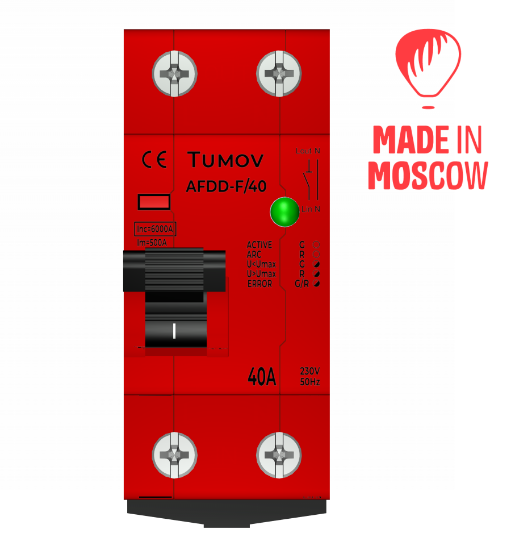

Arc Fault Detection Device, TUMOV


Material: Heat-resistant plastic (polyamide, polycarbonate)
Weight: 240 g
Shelf life: according to using conditions
Tripping time at arcing, ms: in accordance with IEC 62606
Rated current, A: 40
Minimum aring current, A: 2,5
Rated Voltage, V: 115-275
Overvoltage shutdown threshold, V: 275
Tripping time at overvoltage threshold, ms: 200
Tripping time at 300 V, ms: in accordance with EN 50550
Power loss, W: 0,7
Installing and using Arc Fault Detection Devices together with circuit breakers and residual-current devices provides a new level of fire safety for your property. The Arc Fault Detection Device (AFDD) is an intelligent protective module designed to detect and disconnect dangerous electrical arcs before they develop into fires.
Key features
- Intelligent arc recognition — advanced signal‑processing algorithm distinguishes hazardous arc patterns from normal switching and load noises, reducing false trips.
- Fast disconnection — rapid response to detected hazardous arcs minimizes energy release and thermal stress on wiring.
- Compatibility — designed for integration with standard low‑voltage distribution boards and to work alongside miniature circuit breakers (MCBs) and residual-current devices (RCDs).
- Wide application range — suitable for residential apartments, private houses, multi‑unit buildings, offices and small commercial premises.
- Compact design — saves panel space and simplifies installation and retrofit into existing electrical systems.
- Robust build and testing — engineered to maintain reliable operation under typical domestic and commercial electrical conditions.
Benefits for property owners
- Significant reduction of fire risk — modern AFDDs can cut the number of fires caused by electrical faults by more than half when correctly installed and used in combination with other protective devices.
- Increased safety for occupants — early interruption of dangerous arcs protects people and property.
- Lower maintenance and claim risk — fewer electrical failures translate into reduced repair costs and insurance incidents.
- Peace of mind — continuous passive protection without user intervention.
Installation and usage
- Install AFDDs in the distribution board in series with circuit breakers and RCDs according to manufacturer instructions and local electrical regulations.
- Ensure correct selection of AFDD type and rated current for the protected circuit; consult a qualified electrician for load assessment.
- Combine AFDD with overcurrent protection and residual‑current protection to provide comprehensive safety: AFDD targets arc faults, MCBs handle overloads/short circuits, RCDs protect against earth leakage.
- Periodic inspection by a professional is recommended to verify integrity of the electrical system and device condition.
Technical considerations
- AFDDs employ digital filtering and pattern analysis to differentiate series and parallel arcs from harmless electrical events.
- Select devices certified to applicable safety standards and tested under realistic conditions.
- Verify ambient conditions, mechanical dimensions, and terminal compatibility to ensure proper installation in your panel.